




Water Softener Service Guide: Installation, Maintenance, Repair and Replacement
Most homes in North Texas don’t need a lab test to prove the water is hard. The white crust on the shower head and the cloudy film on every glass out of the dishwasher make the point well enough. The harder questions come once you own a softener. Is it actually doing anything? What does it need from you? Is this repair worth paying for, or is it time for a new one?
This guide covers all of it: how a softener works, what a good installation looks like, the maintenance that keeps one going for 15 years, the problems we get called out for most often, when replacing beats repairing, and what each of those costs. If you’d rather have a plumber look at yours, call CR Plumbing, Air and Electric at (940) 370-5663.
Why So Many DFW Homes Have a Water Softener
Fort Worth’s 2025 water quality report lists treated water at roughly 6 to 9 grains per gallon of hardness. The North Texas Municipal Water District, which supplies Plano, McKinney and much of Collin County, describes its own water as moderately hard. Nobody would call that extreme, but it is plenty to line the bottom of a water heater with scale, slowly narrow the inside of pipes, and cut years off a dishwasher or washing machine.
There’s a second local factor most softener guides never mention. Fort Worth, like a lot of utilities in the region, disinfects with chloramine. It does a good job of keeping water safe across miles of pipe, but it is hard on the resin beads inside a softener and wears them out faster. That’s a big reason we often pair a softener with a carbon pre-filter here, and why resin beds in DFW don’t always reach the lifespan printed on the box.
How a Water Softener Works
A softener trades the minerals that cause scale (calcium and magnesium) for sodium or potassium. The trade happens on thousands of small resin beads. As hard water passes through them, the minerals cling to the beads and a little sodium is released in exchange. Once the beads are loaded up, the softener regenerates: it rinses them with salty brine, which knocks the minerals loose and sends them down the drain. Then it’s ready to go again.
Four parts do the work:
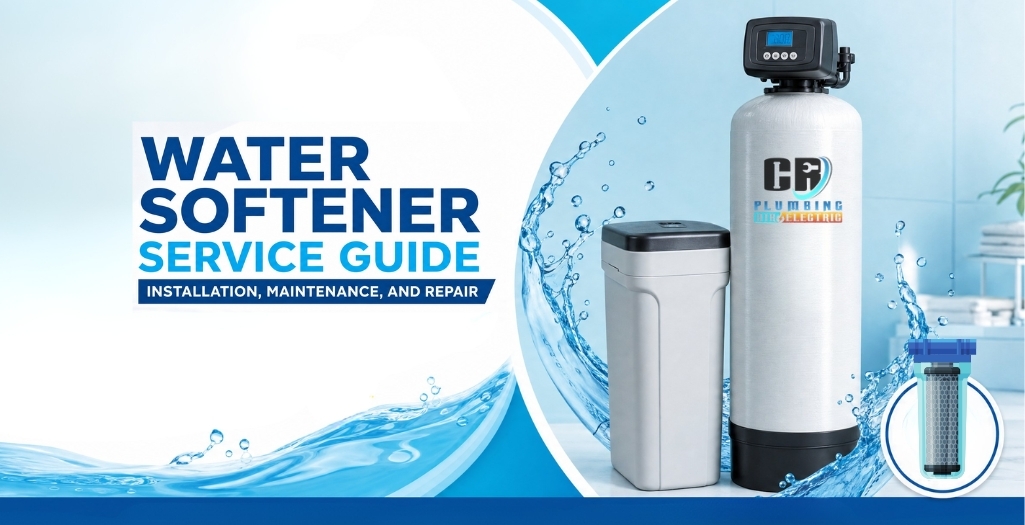
- Resin tank: the tall tank holding the beads. This is where the water actually gets softened.
- Brine tank: the shorter tank you pour salt into. It mixes the brine used during regeneration.
- Control valve: the head on top of the resin tank. It decides when to regenerate, either on a timer or based on how much water you’ve used, and then runs the cycle.
- Bypass valve: lets you take the softener offline while the house keeps running water. Find yours now, before you ever need it in a hurry.
A salt-free water conditioner is a different animal. It doesn’t remove hardness. It changes how the minerals behave so they’re less likely to stick as scale. There’s less upkeep, but you won’t get the slick feel of soft water, and spots on glassware usually stay.
Signs You Need a Softener, or Yours Needs Attention
If you don’t have a softener yet, these are the usual giveaways:
- White or chalky buildup on faucets, shower heads and the inside of the kettle
- Glasses that come out of the dishwasher spotted or cloudy
- Soap and shampoo that barely lather
- Laundry that feels stiff and fades early
- Dry skin and flat hair after a shower
- A water heater that rumbles or pops, or needs repairs more often than it should
- A water test reading above about 7 grains per gallon
If you already have a softener and these start showing up again, it usually means the softener needs service, not that it stopped being worth having. A few more signs point straight at the equipment: the salt level hasn’t moved in weeks, there’s standing water in the brine tank, the water tastes salty, pressure has dropped, or tiny tan beads are turning up in faucet aerators.
Water Softener Installation: What Happens on Install Day
Where the softener goes
A whole house softener goes on the main water line, after water enters the house and before it reaches the water heater. In most DFW homes that means the garage. A lot of newer homes in the area were built with a softener loop already stubbed out in the garage wall, which makes the job quicker and cheaper. If there isn’t one, we run a loop.
Outdoor hose bibs and irrigation usually stay on unsoftened water. There’s no reason to spend salt watering the lawn.
The spot also needs three things: a drain close by (with an air gap, so drain water can never be pulled back into the line), a standard outlet for most control valves, and protection from freezing. The February 2021 freeze taught a lot of North Texas homeowners that a softener in an unheated garage or outside the house can crack. If yours is exposed, it needs insulation or a cover.
What size softener do you need?
Softeners are sized in grains, meaning how much hardness they can remove before they need to regenerate. The quick math is: number of people × 75 gallons a day × your hardness in grains per gallon.
A family of four on 10 grain water uses about 3,000 grains of capacity a day, or around 21,000 a week. A 32,000 to 40,000 grain unit handles that comfortably, regenerating about once a week without being set to burn through salt.
Getting the size wrong costs you either way. Too small and the unit regenerates constantly, wasting salt and water and wearing out early. Too big and you’ve paid for capacity you’ll never use. Iron in the water also eats into capacity, which is why we test before recommending a size.
The installation, step by step
- Test the water for hardness, and check for iron.
- Confirm the location, drain, power and loop.
- Shut off the main and connect the inlet and outlet through a bypass valve.
- Run the drain line with a proper air gap, plus the brine tank overflow.
- Add salt and fill the brine tank.
- Program the control valve for your hardness and household size.
- Run the first regeneration, check every connection for leaks, and test the water at a tap.
With a loop already in place, most installs take 2 to 4 hours. Running a new loop can stretch it to most of a day.
Water Softener Maintenance: What It Needs and How Often
Softeners are low maintenance. They aren’t no maintenance. Most of what keeps one healthy takes a few minutes a month, plus one proper service a year.
Every month (about five minutes)
- Check the salt. Keep the brine tank a quarter to half full. Filling it to the brim doesn’t help and makes bridging more likely.
- Check for a salt bridge. A bridge is a hard crust that forms above the water line, so the tank looks full while the water underneath has no salt in it. Humid summers in a Texas garage make bridges common. Push a broom handle down through the salt, and if it hits a hard layer, break it up gently.
- Glance at the water level. If the water in the brine tank is noticeably higher than usual, something isn’t draining. The repair table below covers why.
Picking the right salt
Evaporated salt pellets are the cleanest option and leave the least residue. Solar salt crystals work fine. Rock salt is cheapest but carries more insoluble grit, which settles at the bottom of the tank as sludge and means more cleaning. Potassium chloride is the sodium-free option. It costs several times more per bag, and you may need to raise the salt setting to get the same result.
Once a year: how to service a water softener
This is the full service, sometimes called a tune up. Here’s what it involves, in the order we do it:
- Put the softener in bypass.
- Scoop out old salt and any sludge, wash the brine tank with dish soap and water, and rinse it well.
- Check and clean the brine line, float and safety float.
- Remove and clean the injector (sometimes called the venturi) and its screen. A clogged injector is one of the most common reasons a softener stops drawing brine.
- Add resin cleaner and run a manual regeneration. This matters more if you see orange or rust staining, which points to iron.
- Check the drain line for kinks and confirm the air gap is still there.
- Inspect the O-rings, bypass and fittings for slow leaks.
- Confirm the clock and hardness settings. Power outages can scramble the settings on older valves.
- Test the water at a cold tap once regeneration finishes. Properly softened water reads 0 to 1 grain per gallon.
Steps 1, 2, 8 and 9 are easy for most homeowners. The injector, valve seals and resin are where a technician is worth paying for, because a small mistake there can leave you with hard water or a leak at the head.
Every few years
Resin beds usually last 10 to 15 years, sometimes less in chloramine-treated water without a carbon pre-filter. If you have pre-filter cartridges, change them on the manufacturer’s schedule, usually every few months. Salt-free conditioners need their media replaced every few years.
How to Tell If Your Water Softener Is Working
- The soap test. Fill a clear water bottle a third of the way from a cold tap, add a few drops of pure liquid soap (castile works), and shake. Soft water gives you a thick layer of suds with clear water underneath. Hard water gives you a thin layer that fades fast and cloudy water below it.
- Test strips. Hardness strips cost a few dollars at a hardware store. Softened water should read 0 to 1 grain per gallon.
- Salt use. The salt level should drop steadily over a few weeks. If it hasn’t budged in a month, the unit probably isn’t regenerating.
- The display. Most control valves show the last regeneration, and many are set to regenerate around 2 a.m. If that date is weeks old, you have your answer.
- How it feels. Soft water feels a little slick in the shower. That’s normal, not leftover soap.
Water Softener Repair: Common Problems and What Causes Them
Before you call anyone, check four things: the bypass is set to service, there’s salt in the tank with no bridge, the unit has power, and the clock and settings look right. Those four solve a surprising number of calls. If they all check out, here’s what’s usually going on.
| Problem | Usual cause | What to do |
| Hard water is back | Salt bridge, empty brine tank, unit left in bypass, clogged injector, wrong hardness setting | Check salt and bypass first. Call if those are fine. |
| Water standing high in the brine tank | Clogged injector or drain line, stuck float, valve problem | Call for service |
| Salt level not going down | Salt bridge, unit not regenerating, clogged injector | Break up the bridge. Call if it keeps happening. |
| Softener not regenerating | Clock reset after an outage, failed motor or timer, wrong settings | Reset the settings. Call for motor or valve problems. |
| Low water pressure | Fouled or broken-down resin, clogged pre-filter, undersized unit, valve issue | Change the pre-filter. Call if pressure stays low. |
| Water tastes salty | Brine not rinsing out because of a drain restriction, low pressure or wrong settings | Call for service |
| Tan beads in faucet aerators | Broken distributor tube or riser inside the resin tank | Call for service |
| Constant running water sound | Worn piston seals or a valve stuck mid-cycle | Call for service |
| Leak at the valve head or bypass | Worn O-rings or loose fittings | Call for service, usually a quick fix |
Water Softener Replacement: Repair or Replace?
Our rule of thumb: if the softener is more than 10 years old and the repair costs more than about half of a new installed unit, replacement usually wins. A new unit resets the clock on every part at once. A repair only fixes the part that failed this time.
Other signs it’s time to replace:
- Resin beads are showing up in your plumbing, or the resin tank is cracked
- The control valve has failed on an older unit, where parts can be hard to find
- You’ve needed more than one repair in the same year
- The household has grown and the softener can’t keep up
- It’s an old timer-based model. Newer demand-initiated valves only regenerate after you’ve used a set amount of water, so they use noticeably less salt and water.
Here’s what a replacement involves. We drain and disconnect the old softener, check the existing loop and bypass (usually they can be reused), set the new unit, program it from a fresh water test, run the first regeneration and haul the old one away. When the plumbing doesn’t need changes, a water softener replacement typically takes 2 to 3 hours.
Whole House Softener, Point of Use, or a Softener and Filter Combo?
A whole house water softener sits on the main line and treats every drop that comes into the home. A point-of-use unit treats one spot, like the kitchen sink. For hardness, whole house is the one that actually protects your water heater, pipes and appliances, so it’s what we recommend in almost every case.
Keep in mind that a softener only handles hardness. It doesn’t remove chlorine or chloramine taste, sediment or other contaminants. That’s what filtration is for. A combo system does both, and in DFW the carbon stage has a bonus: it protects the softener resin from chloramine. If taste and odor matter to you, pair the softener with a whole house water filter.
How Much Does a Water Softener Cost in DFW?
Pricing depends more on your home than on the softener itself. These are typical ranges:
| Service | Typical cost |
| New single-tank salt softener, installed | $1,000 to $3,000 |
| Dual-tank (twin) softener, installed | $2,000 to $5,000 |
| Salt-free water conditioner, installed | $800 to $4,000 |
| Replacing an existing softener | Usually the lower half of the new-install range, since the loop and drain are already there |
| Common repairs (injector, valve seals, float, motor) | $150 to $900 |
| Annual service visit | $100 to $250 |
| Salt | $5 to $10 per 40 lb bag |
What moves the price: whether a softener loop already exists, how far the unit sits from the main line, whether a drain and outlet are nearby, permits where your city requires them, grain capacity, valve type, and whether you add a filtration stage. We give you a written quote after testing your water, so you’re not left guessing from a range.
How Long Does a Water Softener Last?
Ten to 15 years is typical, and a well-kept unit can reach 20. The resin usually goes first, often a little sooner in chloramine-treated DFW water, with the control valve close behind. Three habits stretch the lifespan more than anything else: an annual service, clean salt, and a carbon pre-filter ahead of the softener.
Water Softener Service from CR Plumbing, Air and Electric
We install, service, repair and replace water softeners for homes across North Richland Hills, Watauga, Southlake, Flower Mound, Argyle, Plano and McKinney. Every visit starts with a water test, so the recommendation is based on your water and not a brochure. Our plumbers are licensed, pricing is upfront, and if a repair makes more sense than a new unit, we’ll tell you.
See our water softener installation and repair service, or call (940) 370-5663 to book.

Frequently Asked Questions
How often should a water softener be serviced?
Check the salt monthly and have a full service done once a year. Some newer units on clean water can go longer between services, but with chloramine in most DFW water, once a year is the safer habit.
Do plumbers service water softeners?
Yes. Texas licenses water treatment work, so whoever installs or services your softener should be a licensed plumber or a TCEQ-licensed water treatment specialist. It’s worth asking before you book.
Does a water softener go before or after the water heater?
Before. The softener should treat the water before it reaches the water heater, because the heater is where hard water does some of its most expensive damage.
How long does it take to replace a water softener?
Usually 2 to 3 hours if the existing loop, drain and bypass can be reused. Any changes to the plumbing add time.
Can I install a water softener myself?
Some handy homeowners do. The mistakes we see most are a drain line with no air gap, no bypass valve, and a unit programmed for the wrong hardness. A professional install includes the water test and sizing, which is where a lot of DIY setups go wrong.
Do newer homes still need a water softener?
New pipes don’t change the water coming into them, so yes, if your water is hard. The upside is that many newer DFW homes have a softener loop ready in the garage, which makes installation simpler.
What’s the difference between a water softener and a water filter?
A softener removes hardness minerals. A filter removes things like chlorine, chloramine, sediment and other contaminants. Many homes benefit from both, and a combo system handles them in one setup.
Can hard water damage plumbing even if everything seems fine?
Yes. Scale builds up slowly inside water heaters, pipes and appliance valves long before you notice a drop in pressure or a failed part. A water test is the simplest way to know where you stand.